Help managers find the right procedure and know what to do.
Scattered HR information, situations to handle and few clues to the right answer. I contributed to scoping, research, user flows and page templates for a manager hub delivered on SharePoint in 2026.
The starting point
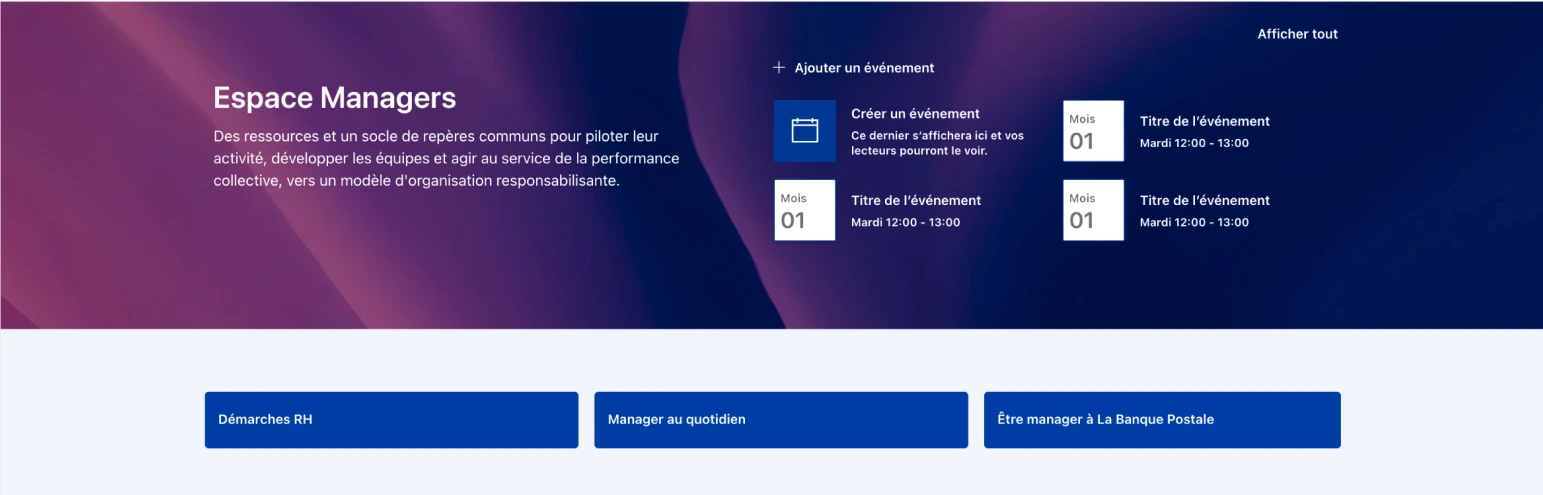
The hub is intended for around 1,000 managers. HR and management information was scattered: before acting, people first needed to know where to look. The challenge was to make resources findable in SharePoint without requiring knowledge of the internal organisation.
My work covered research, information architecture, user flows and page templates, alongside a UX lead and business teams. Content, visual design and development belonged to other teams.
Find what really gets in the way
Nine semi-structured Teams interviews, held from January to February 2026, explored daily work, critical situations, current resources and the ideal hub. The panel included first-time managers, experienced recent joiners and managers established in the group.
The synthesis prioritised finding an HR process and getting help in a difficult situation. It orders the work; it does not statistically describe every manager.
What the interviews helped prioritise
Need confirmed · 9 of 9 interviews
Find an HR process
Priority given to procedures managers need to follow.
Need confirmed · 6 of 9 interviews
Handle a difficult situation
Priority given to support in situations involving an employee.
Need not confirmed · 0 of 9
Receive HR alerts
Recommendation to leave individual alerts out of the first version.
Build three complementary entry points
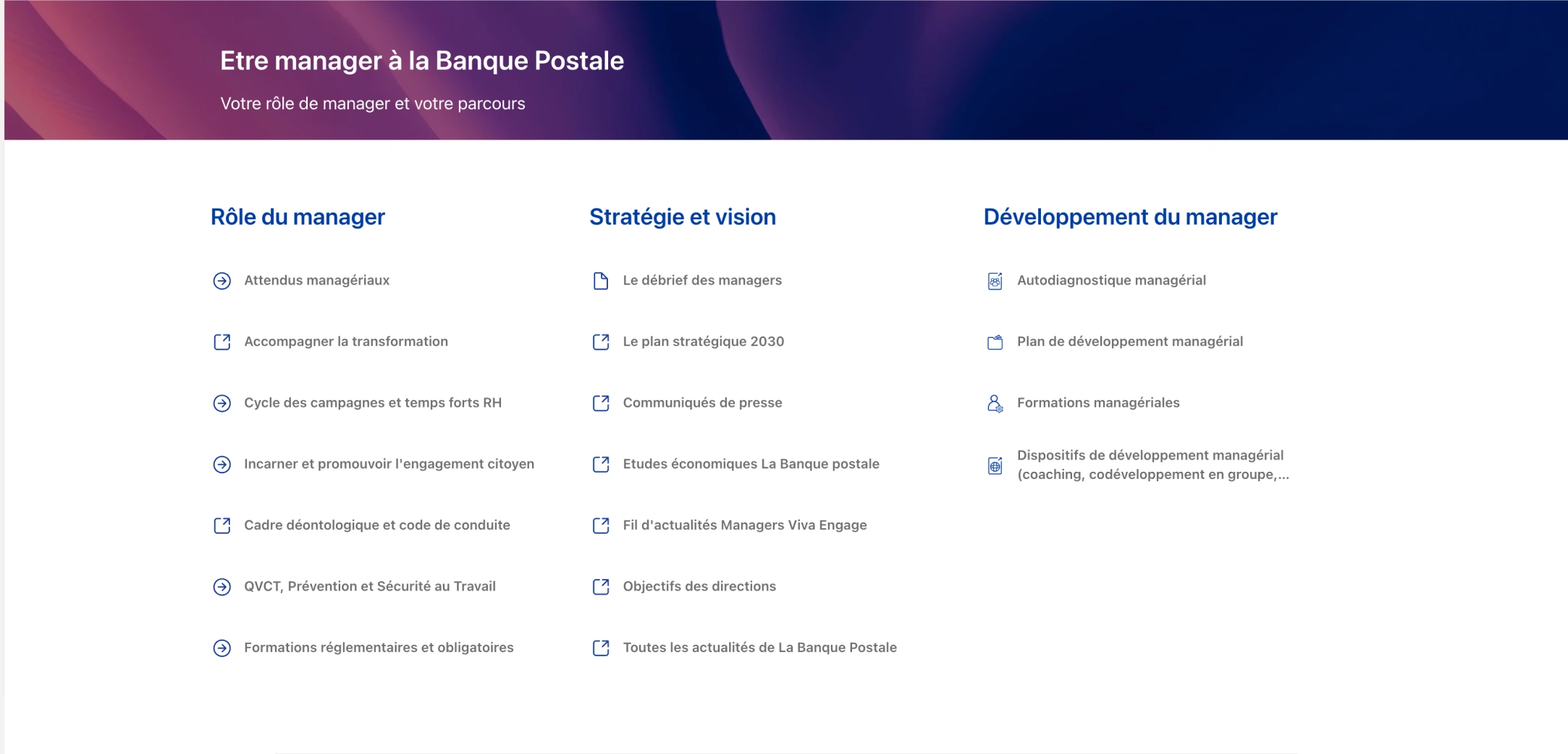
With the UX lead and business teams, I worked on an architecture around three questions: how to follow an HR process, how to act well with a team, and how to understand one’s role and development in the organisation. For a topic such as remote work, people can therefore find rules on one path and team practices on another.
The tests recommend retaining all three entry points. Further work concerns labels and links between pages, not a full redesign of the architecture.
Three entry points, based on the manager’s question
Process
HR processes
What do I need to do?
- Rules and approvals
- Employee journey
Support
Day-to-day management
How do I do it well?
- Team practices
- Tools and methods
Role and growth
Being a manager at La Banque Postale
What is expected of me?
- Role and strategy
- Manager development

Give every page a consistent shape
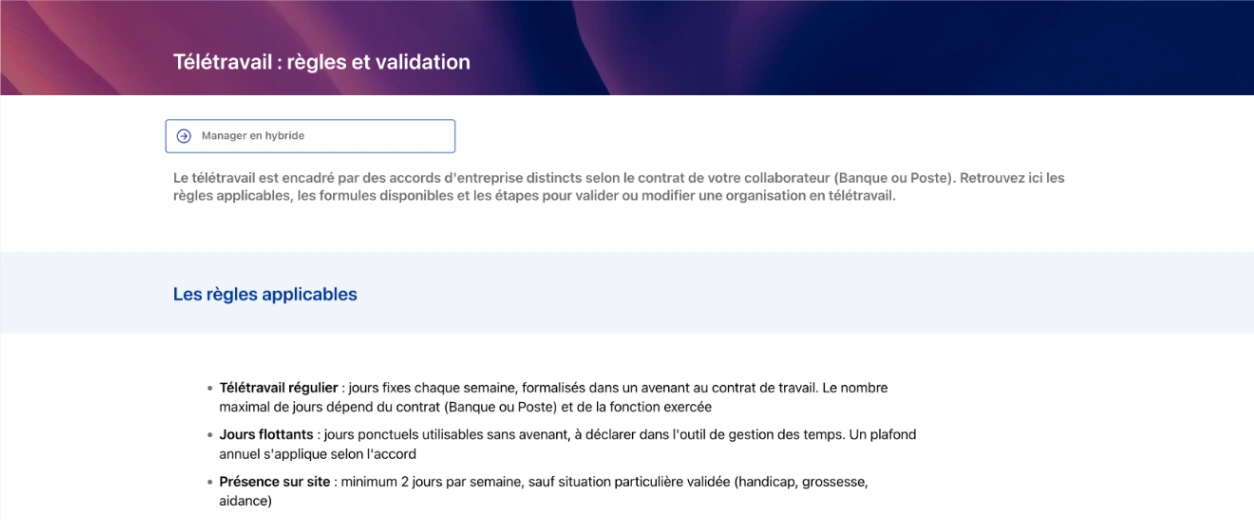
Finding a page is not enough: managers then need to know what to do. The template has six blocks: context, main content in lists or diagrams, a link to the complementary page, a “Questions to consider” checklist, an FAQ and useful resources. I contributed to this structure; content writing and development belonged to other teams.
The checklist helps a manager assess their own situation; the FAQ answers a practical question. That distinction still needed to be made clearer in wording and presentation.
Test paths and fix difficulties
Twelve remote 45-minute sessions ran from 31 March to 10 April 2026. Participants navigated five use cases while thinking aloud, including finding an HR process and preparing an employee’s arrival, then completed a questionnaire. With the team, I evolved the prototype during sessions: descriptive subtitles were added, labels adjusted, links made more visible and the remote-work pages differentiated.
Some changes are documented as completed: “My HR processes” became “HR process”, and “Managing activity” became “Day-to-day management”. Remaining recommendations include clarifying the last two sections, making cross-links bidirectional and making difficult situations easier to find.
Delivery and limitations
The hub was delivered on SharePoint in 2026. My contribution covers scoping, research, information architecture, flows, page templates and recommendations for presenting information. Dedicated teams handled content and technical implementation.
This work made navigation choices and further improvements explicit before handover.
What testing can tell us
Real content, search, mobile and external links were outside the test scope. The prototype changed during sessions, so the results describe this iterative version rather than a product in real use. They measure neither adoption after delivery nor time saved.